




The critical record is a connected chain: original sample, initial preparation, successive dilutions, plated portion and final count. If a link is missing, a clear image and an accurate colony count cannot reconstruct it. The dilution design and handling conditions should follow the applicable laboratory method; this guide focuses on the relationships and records needed to review the result.
Why dilution matters to colony counting
A concentrated sample may produce colonies that are close together, merged or spreading. These conditions can make individual targets difficult to distinguish. A very dilute sample may produce few colonies, making differences between counts more noticeable relative to the observed number.
Choose which dilution levels can contribute to a result using the sample context and the method's rules. The fact that software can display a count does not establish that the plate is suitable for the intended calculation.
The sample matrix also matters. Particles in a food sample, incompletely dispersed material or settling can affect the relationship between portions taken from the same preparation. Equal transferred volumes do not necessarily establish equal sample composition. Preparation, mixing and sampling therefore need their own method records rather than being treated as assumptions made at the counting stage.
Understand the cumulative dilution relationship
A dilution fraction describes the concentration at one stage relative to a stated starting point. If each step produces a concentration that is one tenth of the previous stage, the cumulative fraction is found by multiplying the step fractions.
| Mathematical stage | Fraction relative to the previous stage | Fraction relative to the starting liquid |
|---|---|---|
| Starting liquid | Not applicable | 1 |
| First dilution | 1/10 | 10⁻¹ |
| Second dilution | 1/10 | 10⁻² |
| Third dilution | 1/10 | 10⁻³ |
This table illustrates a mathematical relationship only. It does not prescribe transfer volumes, diluent, mixing, timing or a culture procedure. Those details come from the method selected for the sample.
The last row means that the third liquid has one thousandth of the starting concentration under the assumed dilution relationship. It does not mean that the last step alone was a thousandfold dilution. Keeping both the step fraction and the cumulative fraction prevents that ambiguity.

State exactly what the starting sample is
Distinguish the original liquid, an initial sample homogenate and the subsequent dilution liquids. A fraction of 10⁻³ is incomplete information unless the reference point is named.
For a solid sample, the initial preparation relationship is part of the eventual calculation. Recording only the last dilution can omit the mass-to-volume relationship needed to express a result on the original-sample basis. Keep that information with the preparation record and apply the calculation specified by the method.
The plated volume is another independent input. A dilution label describes the liquid's concentration relative to its reference; it does not tell a reviewer how much of that liquid was placed on a plate. Plate count, dilution and plated volume need to remain separate fields.
Build a traceable dilution record
Use identifiers that let a reviewer work backward from a report to a plate and then to each preparation stage. A record should make the source of every transferred portion explicit.
| Record area | Information to retain |
|---|---|
| Original sample | Identifier, sample matrix and calculation basis |
| Initial preparation | Method, mass/volume relationship and any departure from the procedure |
| Each dilution stage | Previous-stage identifier, step fraction and cumulative fraction |
| Handling record | Required mixing, transfer and consumable information, with exceptions |
| Plate association | Dilution identifier, plated volume, plate identifier and plating method |
| Quality checks | Applicable controls, unusual observations and decisions |
Keep the recorded observations separate from later explanations. If a stage was mislabeled, a transfer source cannot be established or a record skips a stage, preserve the uncertainty and follow the laboratory's review process. Do not fill in a missing dilution by choosing the value that produces an expected colony count.
A practical review question is: “Can another person identify the source liquid for this plate without asking the original operator?” If the answer is no, resolve the record before using the plate in a final calculation.
Connect the dilution record to counting and reporting
After the method's plating and culture steps, assess whether the plate is suitable for reading. Link the accepted count to its plate identifier, dilution record, plated volume and calculation basis.
Spread plating, pour plating, membrane filtration and spiral plating may involve different inputs and calculation rules. Preserve the method identity rather than applying one calculation convention across all plate types. FDA's BAM Chapter 3: Aerobic Plate Count is one official example of a method that specifies its own counting and reporting treatment.
When results are unexpected, review preparation, dilution, plating, culture and image interpretation as separate parts of the record. Contamination, merged growth or disagreement between plates should not automatically be attributed to the counter. Image analysis can support target recognition; it cannot retrospectively correct an undocumented preparation step.
Keep dilution equipment and the colony counter in their own roles
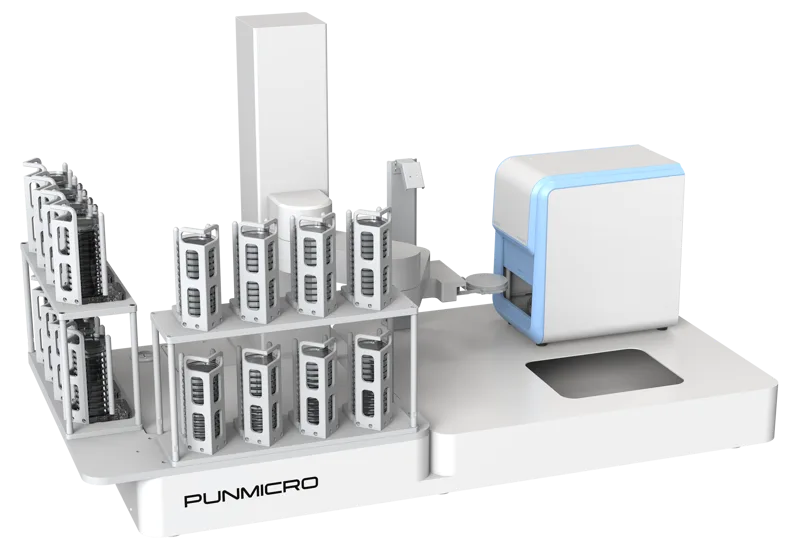
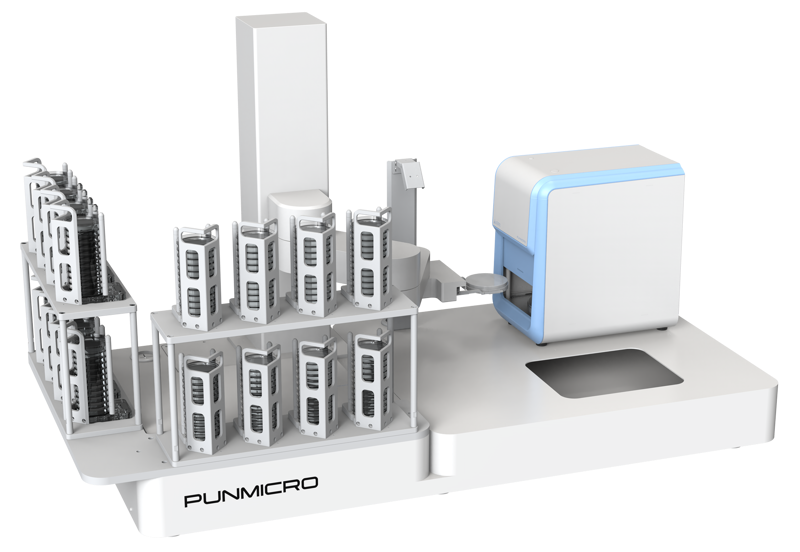
An automated dilution device performs a different task from a colony counter. Its mixing, transfer, consumable and throughput claims need their own model-specific documentation. The use of both devices in a laboratory does not by itself demonstrate an integrated automated workflow.
In this sequence, pun-ICON addresses imaging and counting after growth has formed on the plate. Any proposed connection to other equipment should be evaluated separately for method suitability, sample identity and data transfer.
Continue with how to count colonies on agar for plate assessment, the CFU calculation guide for concentration and unit checks, and spread and pour plate methods for the distinction between plating tasks.
Frequently asked questions
Are the final dilution step and the cumulative dilution the same?
Usually not. The cumulative fraction includes all preceding stages relative to a named starting liquid. Three successive one-tenth stages give a cumulative fraction of 10⁻³.
Can a colony count reveal a missing dilution value?
An expected count is not a reliable substitute for a missing preparation record. Preserve the uncertainty and use the laboratory review process to determine whether the result is usable.
Does an automatic colony counter carry out serial dilution?
The counting task and the dilution task are separate. Confirm the functions of each device and any actual integration rather than transferring the capabilities of a dilution instrument to a colony counter.
References and further reading
- FDA BAM Chapter 3: Aerobic Plate Count · Read the current-edition landing page and linked PDF; used only as an example of method-specific counting and reporting, not a universal dilution protocol.